Jaw pain can be surprisingly disruptive. What starts as mild tightness near the cheeks or ears can turn into clicking when you chew, morning headaches from nighttime clenching, soreness when talking, or a feeling that your jaw is constantly under strain. For many people in Grapevine, TX, these symptoms are linked to the temporomandibular joint, often called the TMJ, and the muscles that control jaw movement.
If you have been searching for TMJ and jaw pain treatment in Grapevine, TX, it helps to understand that jaw discomfort is not always an isolated problem. The jaw is closely connected to the neck, shoulders, posture, stress response, and surrounding muscles. That is why some people explore conservative options such as chiropractic care and acupuncture to help reduce tension, improve function, and support more comfortable movement.
This article explains what TMJ-related pain can feel like, what may contribute to clenching and clicking, and how acupuncture for TMJ in Grapevine, TX and chiropractic for jaw pain in Grapevine, TX may fit into a broader, personalized care plan.
Understanding TMJ and jaw pain
The temporomandibular joints sit on each side of the head, connecting the lower jaw to the skull. These joints work every time you chew, yawn, speak, swallow, or clench your teeth. Because they are used so often, even small issues involving the joint itself or the surrounding muscles can create noticeable discomfort.
TMJ-related pain is often described in different ways, including:
- Jaw aching or tenderness
- Clicking, popping, or grinding sounds
- Pain near the ears
- Difficulty opening the mouth fully
- Facial muscle fatigue
- Morning headaches
- Neck and shoulder tightness
- Teeth clenching or grinding, especially during stress or sleep
Some people have clicking without pain, while others have pain without noticeable joint noise. Symptoms can come and go, or they may build gradually over time.
Common causes of clenching, clicking, and jaw tension
Jaw pain often has more than one contributing factor. A person may clench during sleep, carry stress in the face and neck, and also have poor posture from long hours at a desk. Together, these patterns can overload the jaw muscles and joints.
Teeth clenching and grinding
Clenching, also called bruxism when it includes grinding, is one of the most common reasons people develop jaw soreness. It may happen during the day when concentrating, driving, or feeling stressed. It also commonly happens at night without a person realizing it. Repeated clenching puts pressure on the joint and overworks the muscles of the jaw, temples, and face.
Stress and muscle tension
The body often stores stress in the shoulders, neck, and jaw. Many people instinctively tighten their face, press their tongue against the roof of the mouth, or hold the teeth together during tense moments. Over time, this can create a cycle of tight muscles, soreness, and limited motion.
Neck dysfunction and posture issues
The jaw and neck do not work independently. Forward head posture, rounded shoulders, and stiffness in the upper cervical spine can change how the jaw tracks during movement. If the neck muscles are tight or the head is habitually positioned forward, the muscles around the jaw may have to work harder.
Joint irritation or disc imbalance
In some cases, the small disc inside the temporomandibular joint may not move smoothly, or the joint may become irritated from overuse or strain. This can contribute to clicking, catching, or tenderness when opening and closing the mouth.
Related headaches and facial pain
Jaw tension can trigger headaches around the temples, behind the eyes, or at the base of the skull. Because symptoms may spread beyond the jaw itself, some people do not initially realize that the TMJ area is involved.
When jaw pain deserves closer attention
Mild jaw tension may improve with rest and self-care, but persistent or worsening symptoms should be evaluated. It is especially important to seek appropriate medical or dental assessment if you notice locking of the jaw, major bite changes, significant swelling, recent trauma, fever, or severe pain. These signs may point to issues that require a different kind of care.

For non-emergency musculoskeletal jaw tension, many people look for conservative approaches that focus on muscle relaxation, mobility, and reducing mechanical stress.
How chiropractic may help jaw pain
Chiropractic for jaw pain in Grapevine, TX is often considered when TMJ discomfort appears to be connected to neck tension, posture, upper back restriction, or muscle imbalance. Chiropractic care does not just focus on the painful spot. It looks at how the jaw functions within the larger musculoskeletal system.
Supporting alignment and motion in related areas
The jaw is influenced by the cervical spine, upper shoulders, and surrounding muscles. If the neck is stiff or posture is strained, the jaw may compensate. A chiropractic approach may include evaluating joint motion in the neck and upper back to see whether restricted movement is adding stress to the jaw region.
Reducing muscle tension patterns
Jaw pain often involves overactive muscles in the cheeks, temples, scalp, and neck. Manual therapy, soft tissue work, and movement-focused care may help decrease this tension. When the surrounding muscles relax, opening and closing the jaw may feel easier and less painful.
Improving posture habits
Many people spend hours each day looking down at phones, working at computers, or driving with their head pushed forward. These positions can strain the upper body and contribute to jaw problems. Chiropractic care often includes postural education and exercises that encourage better head and neck positioning, which may lessen ongoing irritation.
Addressing related headaches and neck discomfort
Because TMJ issues often overlap with tension headaches, neck pain, and upper shoulder tightness, a whole-body musculoskeletal approach can be valuable. Improving movement and reducing strain in nearby structures may help calm the cycle that keeps jaw pain active.
How acupuncture may help TMJ symptoms
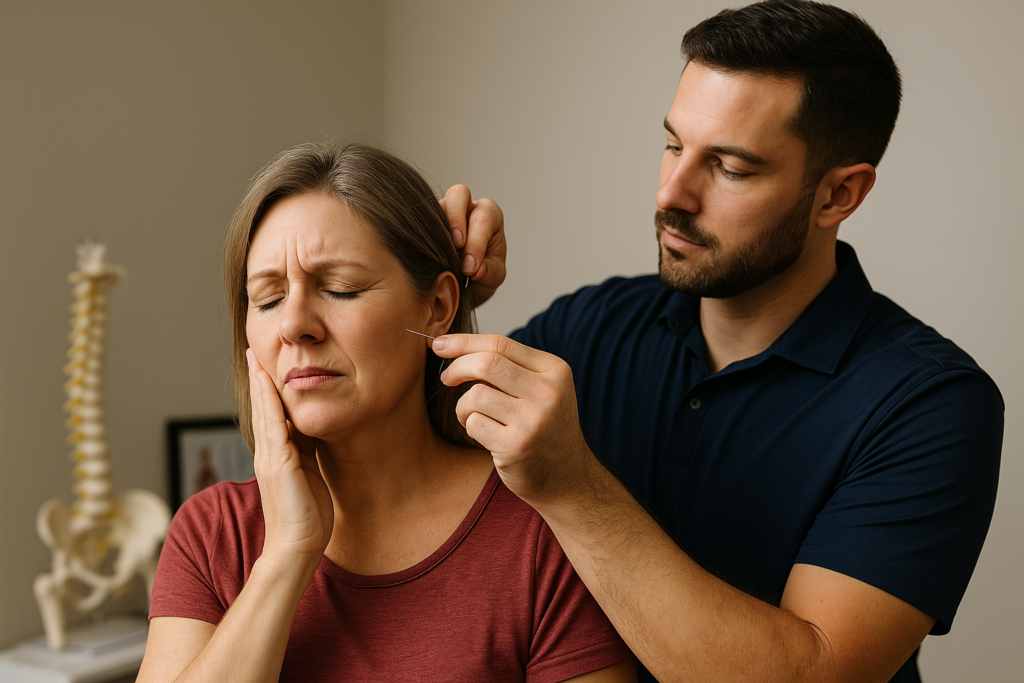
Acupuncture for TMJ in Grapevine, TX is another conservative option many people consider for jaw tension, clenching discomfort, and facial tightness. Acupuncture is commonly used to support pain relief, promote relaxation, and help reduce muscle guarding.
Encouraging muscle relaxation
One of the biggest challenges with jaw pain is that tight muscles tend to stay tight. Acupuncture may help encourage the body to relax these areas, especially in the jaw, temples, neck, and shoulders. This can be particularly helpful for people who feel like they are constantly clenching without meaning to.
Supporting pain modulation
Acupuncture is often used as part of a pain management strategy because it may influence how the nervous system processes discomfort. For people with recurring jaw soreness or tension headaches tied to TMJ symptoms, this may offer another pathway to relief.
Helping with stress-related tension
Stress is one of the most common triggers for daytime clenching and nighttime grinding. Acupuncture is frequently chosen by people who want an approach that supports both physical tension and the stress component that often drives it. When the body is less guarded overall, the jaw may feel less reactive.
Working well with multimodal care
Acupuncture is often used alongside other conservative treatments such as chiropractic care, therapeutic exercises, soft tissue therapy, and home care strategies. Because TMJ discomfort is often multifactorial, combining methods may be more useful than relying on a single solution.
A personalized approach matters
Not all jaw pain behaves the same way. One person may mainly have clicking without much pain. Another may wake up every morning with clenched teeth, temple headaches, and tight neck muscles. Someone else may develop jaw discomfort after a car accident, sports injury, or prolonged desk work.
That is why personalized care is so important. A thoughtful evaluation looks at more than the joint itself. It may consider:
- Whether symptoms are more muscular, joint-related, or posture-driven
- When clenching tends to happen
- How the neck and shoulders are functioning
- Whether headaches are part of the pattern
- What daily habits may be aggravating the jaw
- How long the symptoms have been present
At Chiro & Acupuncture Inc., personalized treatment is a central part of care. The goal is to target each person’s unique pain pattern rather than apply a one-size-fits-all approach.
Where modern technology may fit into care
Some practices combine hands-on and traditional methods with newer technology to support healing. Chiro & Acupuncture Inc. also offers Stemwave therapy, which uses sound waves to stimulate tissue regeneration and reduce inflammation. While it is commonly discussed in relation to conditions such as sciatica, tendonitis, and other pain issues, a broader integrated approach can be useful for patients dealing with complex musculoskeletal tension patterns.
For jaw-related discomfort, the value of an integrated clinic model is that multiple tools may be available to address inflammation, soft tissue irritation, movement dysfunction, and compensatory pain in nearby areas such as the neck and shoulders.
Practical examples of TMJ-related patterns
The nighttime clencher
A person wakes up with sore cheeks, temple pressure, and tightness around the ears. Their teeth may feel sensitive, and they may notice headaches by mid-morning. In this kind of case, treatment may focus on reducing muscular tension, calming irritation, and improving neck and postural mechanics that may be contributing to the pattern.
The desk worker with forward head posture
Someone who spends long hours at a computer may develop neck stiffness, upper shoulder tension, and a jaw that clicks when eating. Here, the issue may not be the jaw alone. Addressing posture, cervical mobility, and soft tissue tension may be important parts of care.

The stress-related daytime clencher
Another person may notice that their jaw tightens during traffic, work meetings, or concentration-heavy tasks. They may not have major joint problems, but the muscles are overworking all day. Treatment may center on relaxation, body awareness, tension reduction, and supportive self-care strategies.
Self-care strategies that may help between visits
Conservative treatment often works best when combined with simple home habits. These steps are not a substitute for evaluation, but they may help reduce aggravation.
Keep the jaw in a relaxed resting position
When not eating or speaking, the lips can stay together while the teeth remain slightly apart. Many people unconsciously hold their teeth together all day, which keeps the jaw muscles active.
Use gentle awareness for clenching
Set reminders during the day to check whether your jaw is tight. If it is, soften the cheeks, relax the tongue, and let the shoulders drop.
Modify chewing habits temporarily
If symptoms are flared up, it may help to limit very chewy foods, gum, wide yawning, and biting into hard foods that force the jaw to work harder.
Support better posture
Keeping screens at eye level, avoiding long periods with the head pushed forward, and taking movement breaks may reduce strain that travels upward into the jaw.
Address overall tension
Breathing exercises, stretching, and stress-management habits may indirectly help the jaw by reducing the tendency to brace and clench.
Benefits of conservative care for jaw pain
People exploring teeth clenching tension relief in Grapevine, TX often want options that are practical, individualized, and focused on function. Conservative approaches such as chiropractic and acupuncture may offer several potential benefits:
- Reduced muscle tightness in the jaw, face, neck, and shoulders
- Improved comfort when chewing, talking, or yawning
- Support for better jaw movement
- Help with associated headaches and upper body tension
- A non-surgical, movement-oriented approach
- Care that can be adapted to the person’s specific symptom pattern
Results vary from person to person, and the best plan depends on the underlying drivers of the discomfort. Still, for many people, a conservative musculoskeletal approach is a reasonable place to start when symptoms are related to tension, mobility, and functional strain.
Important considerations before starting treatment
Jaw pain can overlap with dental issues, sinus problems, arthritis, nerve irritation, and injury-related conditions. That is why a proper assessment matters. A responsible treatment plan should consider whether the symptoms appear musculoskeletal or whether referral for dental or medical evaluation may be appropriate.
It is also important to set realistic expectations. TMJ symptoms often build over time, especially when clenching, posture, and stress are part of the picture. Improvement may require a combination of in-office treatment, habit changes, and consistent follow-through with self-care.
Finding the right TMJ and jaw pain treatment in Grapevine, TX
If you are comparing options for TMJ and jaw pain treatment in Grapevine, TX, it is worth looking for a provider who understands the connection between the jaw, neck, posture, headaches, and muscle tension. A broader view can be especially helpful when symptoms include clenching, clicking, facial tightness, and tension that extends into the shoulders or upper back.
An integrated clinic may be able to combine traditional approaches with modern therapies, while keeping treatment tailored to your symptoms and response over time. That individualized strategy can be especially valuable when jaw pain is not caused by just one issue.
Conclusion
TMJ discomfort can affect much more than the jaw. It can interfere with eating, speaking, sleep, concentration, and daily comfort. Clenching, clicking, and tension often involve a mix of muscle overuse, stress, posture, and neck dysfunction, which is why the most helpful care is often broader than the joint alone.
For people seeking chiropractic for jaw pain in Grapevine, TX or acupuncture for TMJ in Grapevine, TX, these conservative therapies may help reduce muscle tension, support healthier movement, and address related patterns involving the neck and upper body. When paired with personalized evaluation and thoughtful self-care, they may play a useful role in a comprehensive plan for jaw comfort and function.
Understanding the root causes of your symptoms is the first step. From there, a personalized, whole-body approach may offer a practical path toward less tension, fewer flare-ups, and better day-to-day comfort.